Introduction
When planning a luxury interior project in India, the most critical decision isn’t the color of the laminate or the brand of the kitchen appliances—it’s the “Carcass” material. In 2026, the Indian plywood market has evolved. Homeowners are no longer asking for “any waterproof ply“; they are demanding health-safe, machine-precise, and lifetime-durable boards. Among the sea of legacy brands, one name has consistently disrupted the premium segment by focusing on engineering rather than just marketing:
Thames Ply.
In this exhaustive guide, we break down why modern Indian architecture is moving away from standard commercial boards and toward the high-tech world of 4-times calibrated and E0-emission plywood.
1. Understanding the Indian Plywood Grading System
To the average buyer, plywood looks the same. To a structural engineer, the difference between an IS:303 and an IS:710 board is the difference between a cabinet that lasts 3 years and one that lasts 30.
IS:303 (Moisture Resistant – MR)
Commonly called “Commercial Ply,” this is the entry-level grade. While brands like Thames Prime MR offer significantly better termite resistance than local unbranded alternatives, MR grade is strictly for dry areas like bedroom ceilings or wall paneling.
IS:710 (Boiling Water Proof – BWP)
This is the “Marine Grade” standard. To qualify, a board must survive 72 hours of boiling water without any layer separation. Thames Titanium and Thames Platinum don’t just meet this standard; they exceed it, using undiluted Phenol Formaldehyde (PF) resins that create a permanent chemical bond.
2. The 2026 Shift: Why "Calibration" is the New Minimum
If you are building a modular kitchen, standard plywood is your enemy. Why? Because standard plywood thickness fluctuates. A “19mm” local board might be 18.5mm in one corner and 19.5mm in another.
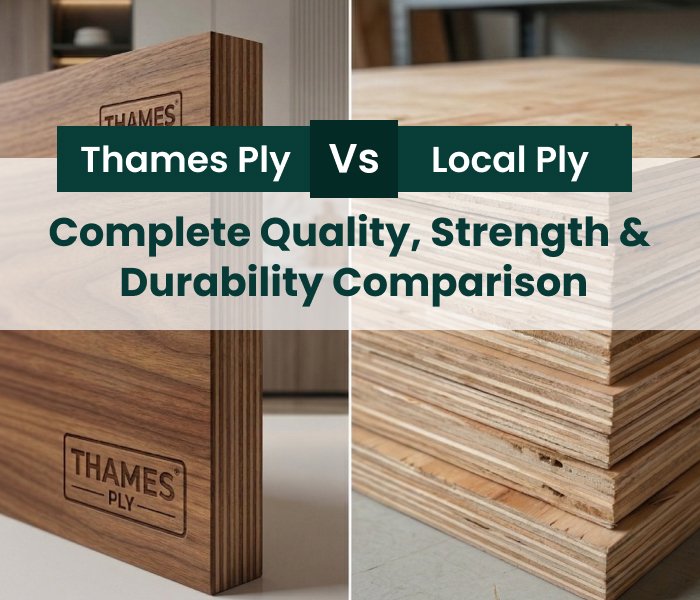
Thames Ply has pioneered the “4-Times Calibration” process in India. Using heavy-duty wide-belt sanders, every sheet is sanded four times to achieve a uniform thickness with a tolerance of just ±0.1mm
Why Calibration Matters for Your Home:
- CNC Precision: Modern modular factories use CNC machines to cut wood. If the thickness is uneven, the joints won’t fit. Thames Ply ensures a “Lego-like” assembly.
- Mirror-Finish Laminates: Have you ever seen “waves” on a highgloss wardrobe? That’s caused by the uneven surface of the plywood beneath it. Thames’ mirror-smooth surface eliminates this
“telegraphing” effect. - Hardware Longevity: Expensive soft-close hinges (like Hettich or Hafele) require a perfectly flat surface to function. On uneven ply, these hinges lose alignment within months.
3. The Silent Killer: Formaldehyde Emissions and E0 Standards
In 2026, health is a luxury. Most Indian plywood uses glues that release formaldehyde—a known carcinogen—into your home’s air. In closed, airconditioned apartments, these toxins accumulate. Thames Ply has taken a stand by shifting its premium ranges to E0 Emission Standards.
- What is E0? It is a European safety rating that ensures the
formaldehyde release is nearly zero. - Who is it for? It is mandatory for children’s rooms, hospitals, and any luxury residence where indoor air quality is a priority.
4. Thames Platinum vs. Thames Titanium: Which One Do You Need?
As an SEO authority, we look at the specs. Here is how the Thames flagship products stack up for different project needs.
Thames Platinum: The “No-Questions-Asked” Legend
This is the pinnacle of Indian plywood. Crafted using 100% Gurjan wood and high-density imported hardwood, it is designed for extreme environments.
- Warranty: Lifetime Warranty (No Questions Asked).
- Key Feature: Fire-resistant properties (IS:5509) and GLP (Glue Line Protection) technology.
- Best For: Luxury villa kitchens, coastal homes, and heavy-duty structural use.
Thames Titanium: The Architect’s Choice
Titanium is the workhorse of the premium sector. It offers the same 4-times calibration and E0 safety as the Platinum range but is optimized for high-end residential interiors.
- Warranty: 30 Years.
- Best For: Wardrobes, office furniture, and bathroom vanities.
5. The Economics of Quality: Is Thames Ply Worth the Premium?
As an SEO consultant, I often see users searching for “cheapest 18mm plywood price.” But “cheap” plywood is an illusion
The Math of a Failed Kitchen:
- Local Ply Kitchen: ₹2,00,000 (Lasts 5 years). Cost per year: ₹40,000.
- Thames Ply Kitchen: ₹2,50,000 (Lasts 25 years). Cost per year:
₹10,000.
When you factor in the cost of labor, laminates, and the sheer headache of a renovation, Thames Ply is actually 75% cheaper over the lifespan of your home.
6. How to Spot Counterfeit Plywood in the Indian Market
The “Best Plywood in India” tag attracts many fakes. To protect your investment, always check for:
- The Digital Caliper Test: Measure the sheet thickness. If it varies by more than 0.2mm, it is NOT Thames Calibrated.
- The QR Verification: Scan the unique code on the sheet to verify the
batch and manufacturing date. - The Core Composer: Look at the side of the board. You should see solid, gap free layers. If you see hollow holes, it is a local “filler” board.
7. Conclusion: The Final Verdict for 2026
If your project demands perfection, standard plywood is no longer an option. The combination of 4-times calibration, E0 health safety, and BWP durability makes Thames Ply the benchmark for the industry. Whether you are a developer looking for “BWP structural grade” or a homeowner wanting a “Zero-Emission” bedroom, the data is clear: Thames Plywood is the foundation of a modern, healthy Indian home.